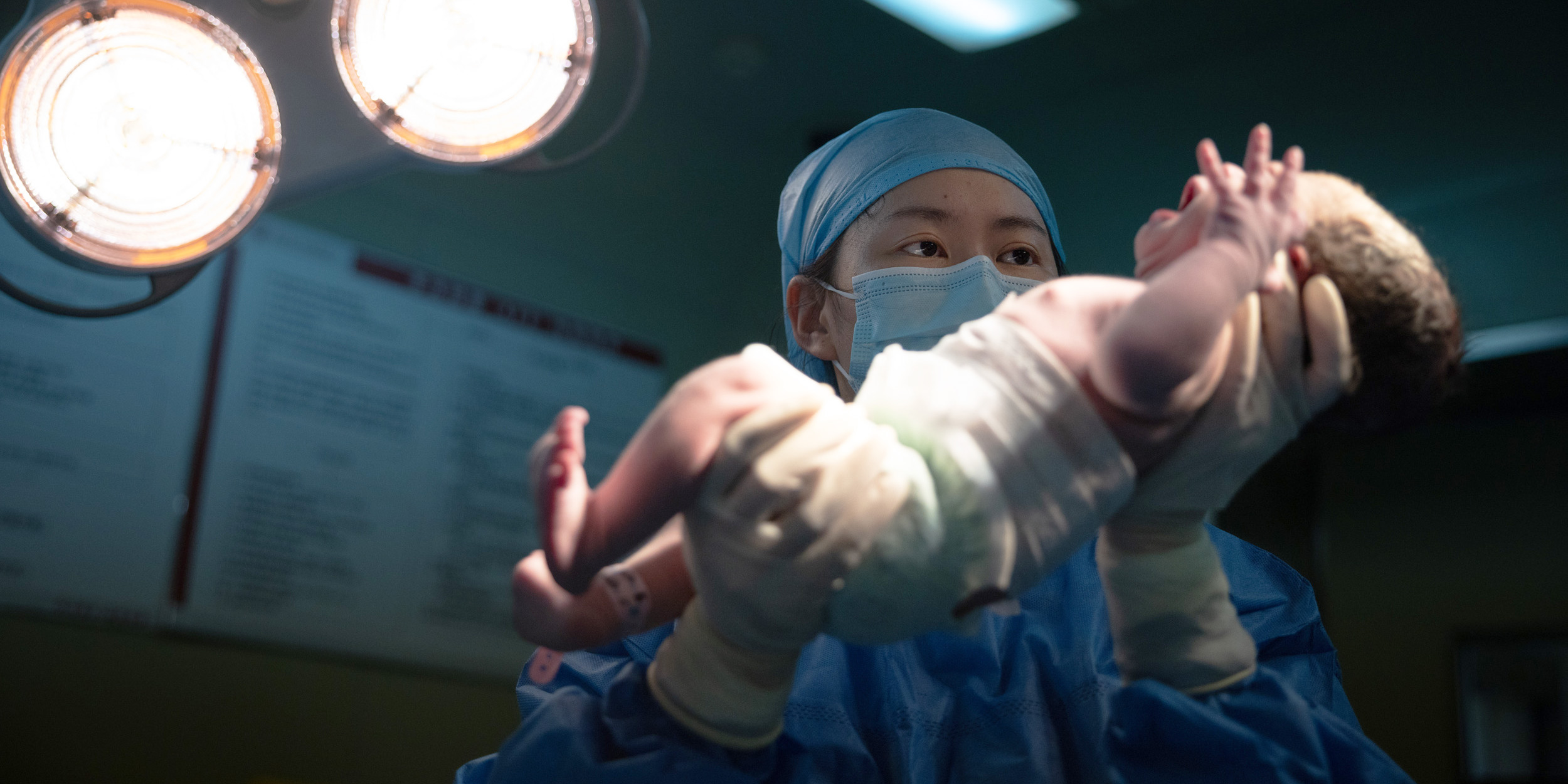
Pushed Out as Demand Falls, China’s Obstetricians Start Over
This story is part of Sixth Tone’s 10-year anniversary series, Ten Years in Transition.
In her first decade as an obstetrician, Zhang Xuan bounced between surgeries, overnight shifts, and deliveries that could come at any hour. Once, she went 72 hours without proper sleep, snatching brief naps on a stool when she could.
By her second, China’s births were falling fast enough to alarm policymakers. Zhang’s pay had stalled, her prospects were narrowing, and on some days, she says, there were more medical staff than pregnant women — enough to convince her it was time to leave.
Today, at 43, Zhang sells insurance.
“It’s hard to say it was an impulsive choice,” Zhang, hailing from a small city in central China’s Hubei province, said of leaving obstetrics in 2016. “It was more like countless regrets piling up.”
That was also the year China ended its one-child policy and allowed all couples to have two children, hoping to slow a demographic decline. Any reprieve was brief.
Even after authorities later raised the limit to three children and rolled out incentives such as cash subsidies, longer parental leave, and housing support, births kept falling, dropping to a low of 7.92 million in 2025.
For obstetricians, the decline meant emptier wards, fewer deliveries, and mounting pressure on departments that had once seemed indispensable. Some were merged, some scaled back, and some disappeared altogether.
By 2024, the crisis had become visible enough that Duan Tao, now director of obstetrics at Shanghai East Hospital and one of China’s best-known obstetricians, publicly urged people to “save obstetrics,” warning that the specialty was “collapsing.”
That year, the National Health Commission designated delivery services a basic medical service, ordered counties to preserve public delivery services, and called on hospitals to protect obstetricians’ pay.
By then, some from Zhang’s generation were already on their way out of the profession. For medical students, fertility medicine briefly looked like one of the field’s few bright spots before that route grew crowded, too.
And though most stayed, they remained in a field being cut back and remade as hospitals searched for ways to survive beyond delivery care alone.
Exit strategies
Shi Jiyue is one of the doctors who chose to stay.
“As an intern, I fell in love with obstetrics right away,” Shi tells Sixth Tone, using a pseudonym for privacy. “Compared with other departments, it felt farther from disease and death. Holding those soft, reddish newborns, I felt something sacred calling me to this work.”
Now chief obstetrician at a municipal general hospital in a fifth-tier city in northeastern China, Shi has watched births at her hospital fall to about half what they were in the 2000s, when the ward handled up to 300 deliveries a month.
By 2024, some general hospitals across the country had stopped offering delivery services, while specialized maternity hospitals were being shut down or folded into larger systems.
“And worse still, general hospitals are reluctant to absorb them,” Shi says, referring to specialized maternity hospitals. “They often lose money and are seen as a burden.”
Zhang saw that burden unfold up close at the hospital where she worked. By the time she left, monthly births had fallen to fewer than 30, down from around 100 when she started. Her salary rose from 3,000 yuan ($439) a month to 7,000 ($1,024) in her first decade on the job, then barely moved again.
For doctors of Zhang’s generation, the timing was especially punishing. They entered the field when a bachelor’s degree was often enough, only to find promotion growing harder as younger, more highly educated colleagues crowded in. Outside the hospital, there were few obvious exits; inside, advancement was narrowing.
Even after China began loosening birth restrictions, little changed in the wards where Shi worked. In her clinic, Shi often urged couples who had accidentally conceived a second child to keep it. “But the answer was always no,” she says.
By February, the downturn had reached a top-tier hospital in Guangzhou, the capital of southern China’s Guangdong province. A former midwife says she resigned after her department began cutting salaries by 1,000 to 2,000 yuan a month and laying off staff.
“I thought about leaving for a long time,” the woman in her 30s told Sixth Tone, using a pseudonym for privacy. “It was hard to let go — the feeling of being needed, the colleagues who fought alongside me.”
She now lives in Hubei’s capital, Wuhan, with her husband and child, helping at the beef noodle shop he runs. She says she does not plan to return to obstetrics. With lower academic credentials, she feels shut out of top hospitals.
In a sign of how far basic obstetric care had already retreated, the National Health Commission in 2024 ordered counties with populations above 300,000 to maintain at least two public delivery service providers, while smaller counties had to keep at least one.
It also said public hospitals should strive to keep obstetricians’ pay no lower than the average for hospital physicians and barred them from assigning revenue targets to obstetrics staff.
But fewer and fewer medical students are choosing obstetrics, doctors say, while those already in the field are switching specialties, or opting out of hospital work altogether.
“They’re like frogs slowly boiled in warm water,” Zhang says.
Window of opportunity
As delivery wards in smaller cities emptied out, fertility clinics in major cities still looked busy enough to suggest a different future.
Yu Mengqiu caught that window when she entered a fertility clinic in Shanghai as an intern around 2016, just as China’s two-child policy took effect, and was later retained as a doctor.
As authorities looked for ways to boost births, they expanded support for Assisted Reproductive Technology (ART) and encouraged hospitals to open infertility clinics. At the time, more than 12% of married couples in China were estimated to face infertility, and the share of babies born with ART had risen from 0.46% in 2009 to 2.37% in 2018.
“I’ve seen childbearing age being pushed later and later. And more are relying on assisted reproductive technologies to conceive babies,” Yu tells Sixth Tone, using a pseudonym for privacy.
“We call them ‘precious babies,’” she adds, referring to children conceived only after difficulty, often with medical assistance.
Unlike the lukewarm response doctors described in lower-tier cities, financially secure urban couples born in the 1970s and 1980s rushed to have another child while they still could.
Assisted reproduction was only part of the business. Genetic screening and related services also brought a steady stream of patients. “Some people only want one child,” Yu says, “but they’re willing to spend more to protect themselves and the baby.”
But, she adds, “the good days didn’t last.”
As fertility clinics opened in smaller cities and drew patients closer to home, positions in major city centers became harder to come by. The newer clinics, meanwhile, often preferred experienced doctors over fresh graduates.
So by the time Li Shuhua, who is set to graduate this June, entered reproductive science, the window had already begun to close.
She still remembers the first time she held an embryo dish in the lab. Her hands shook with excitement and nerves. The egg was so small, she says, it hardly seemed possible it could become a life. That was the moment she felt closest to the future she wanted.
Now, after eight years of medical training, she can hardly find openings in fertility centers. “I was very idealistic when I decided to become a doctor. I thought it was a way to contribute to society,” Li says, her voice breaking over the phone. “Now there are countless moments when I want to give up.”
She widened the search to pharmaceutical companies and medical journals, with little to show for it.
Yu had already seen the squeeze from the other side. Positions at fertility clinics became “oversaturated,” she says, leaving younger doctors with fewer and fewer ways in.
“I often look at the younger intern doctors and feel so sorry for them. They’re all very good. But there’s simply no room left for them,” Yu says.
More than that, she says, the broader math had turned against the field. “Individuals may be more willing to pay, but the overall decline in demand is overwhelming.” Last year, Yu left the fertility center to join a pharmaceutical company.
Shi, still working in obstetrics, sees no real separation between the two paths. “At its core, obstetrics and fertility centers face the same problem: people are simply unwilling to have children,” she says.
Pay for care
Yet for the many families still choosing to have children, the shrinking obstetrics system has created a new hierarchy of care.
A mother surnamed Cao from eastern China’s Zhejiang province learned that firsthand in May 2024. She was 58 days from her due date when the private hospital where she had booked her delivery told her its obstetrics department head was leaving, no replacement had been found, and the unit would shut down because there were not enough staff to keep it running.
“I was very anxious,” Cao says, using only her surname for privacy. “The hospital had such a good reputation — how could it suddenly close like that? I never expected something like this.”
The hospital refunded Cao’s deposit and paid the same amount in compensation, while local authorities directed expectant mothers to two public specialist hospitals. In the end, she chose another private hospital, drawn by its “service attitude,” several days of maternity nanny care, and the fact that the public option could not guarantee a private room.
But at a top public hospital in Shanghai known for its obstetrics department, Wei Wen says there is no such slack. As delivery services disappear in lower-tier cities and more patients are funneled into a narrower band of top-tier wards, she is still working around the clock.
Wei stayed, even as that meant relentless hours and mounting pressure. “Every time I successfully deliver a baby, the gratitude from patients is very real,” she says. “You’ve completed something and helped someone.”
In obstetrics, she adds, expectations are unusually high, and maternal mortality remains a key measure of a country’s health care system. “Not a single case can go wrong.”
As public hospitals adapted, Wei explains, her department began borrowing more openly from the private playbook. VIP services were built around senior specialists and midwives, dedicated messaging groups, and fees that can exceed 100,000 yuan — more than 10 times the standard rate.
Beyond the existing “specialist priority clinics,” even more expensive premium services were rolled out. Doctors were also told to improve their “service attitude,” even during exhausting night shifts.
“Public maternity wards are gradually becoming more like private ones,” Wei says, using a pseudonym for privacy.
Even back in 2016, Zhang says, her department was already offering add-ons such as infant swimming, massage, pelvic floor rehabilitation, and postpartum yoga. Yu says her fertility clinic later started a social media account to attract patients, as expectant mothers increasingly turned online to decide where to seek care.
Patients have noticed the change, too. For her first child in 2021, a Shanghai mother surnamed Zhang, unrelated to Zhang Xuan, chose a private hospital, where the delivery cost around 80,000 to 100,000 yuan.
By the time she became pregnant again, in 2025, she was over 35 and worried about complications. This time, she paid 30,000 yuan for a VIP slot at one of the city’s top public maternity hospitals, bringing the total to roughly the same amount. As she put it, prices had “inverted,” as public hospitals had begun rolling out even more expensive premium maternity services.
Duan Tao says hospitals have increasingly been left to find their own ways to survive. For primary-level hospitals where deliveries are falling, he tells Sixth Tone, the options often come down to “closure, suspension, merging, or transition.”
For specialist hospitals that remain, survival means expanding beyond delivery care. “You either move upstream, focusing on areas such as preterm birth prevention, fertility treatment, and reproductive health, or downstream into services like postpartum care, rehabilitation, dermatology and cosmetic medicine, anti-aging, traditional Chinese medicine, or mental health,” Duan says.
“If you rely on obstetrics alone, without these related services, it’s basically impossible to sustain.”
Since taking over at Shanghai East Hospital, Duan says he has focused on building a reputation around a handful of procedures, including the prevention and management of preterm birth, cervical cerclage — a stitch used to help keep the cervix closed during pregnancy — and external cephalic version, a technique used to turn a breech baby before delivery.
“This is craftsmanship,” he says. “Even a traditional technique has to become your signature skill.”
Zhang believes the future will likely consist of large top-tier hospitals alongside smaller community hospitals, with international departments catering to wealthy patients. “The ones in the middle,” she says, “will be eliminated or absorbed.”
She chose to leave before that future fully arrived. Now, she leads a 50-person insurance team, has more time to watch her child grow up, and finally gets enough rest. Her income is at least three times what she earned as a doctor.
“After leaving medicine,” she wrote on social media, “I finally started living like a normal person.”
Contribution: Yang Yang; editor: Apurva.
(Header image: A nurse checks on a newborn at a hospital in Hangzhou, Zhejiang province, May 2025. Ni Yanqiang and He Chang/VCG)